Why low-dose delivery needs its own verification strategy
A device that performs well at a larger dose cannot be assumed to have the same relative error at its minimum dose.
Evidence approachLow-dose accuracy and reproducibility statements follow PubMed-indexed studies. Mechanism and container constraints come from device and container documentation.
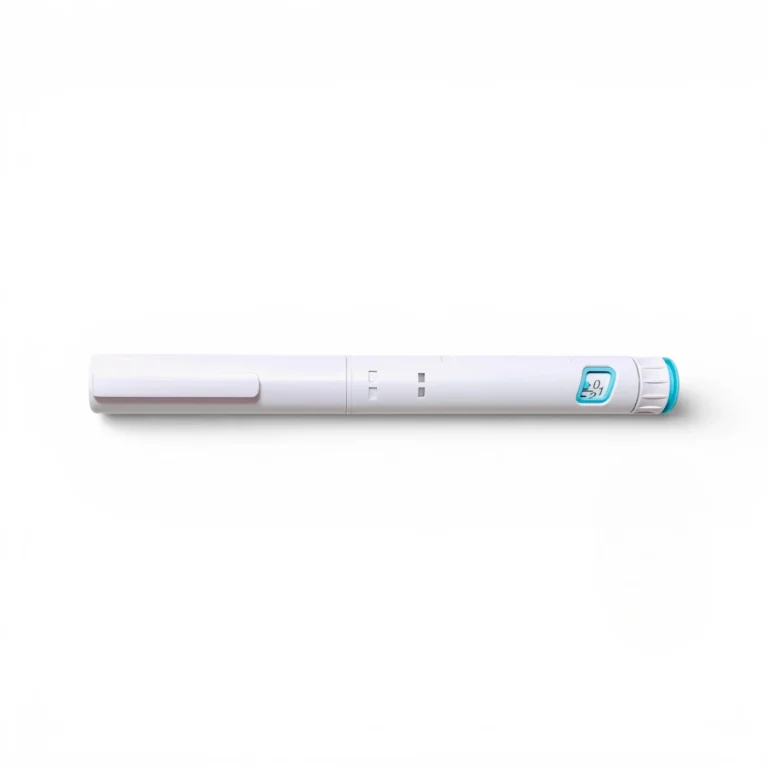
Representative adjustable dose platform view for engineering discussion only. Final suitability requires configuration specific evidence.
What the research found
A pediatric study compared 1, 2, 5 and 10-unit delivery from pen injectors and syringes. Relative error was most problematic at 1 unit. The pens were more accurate than syringes at several small doses, yet the authors still considered 1-unit delivery insufficiently accurate across the tested methods.
Engineering interpretationMinimum-dose performance deserves dedicated sampling. Residual volume, mechanical resolution, user setting error, priming and measurement uncertainty become proportionally more important as dose decreases.
Connection to Penacta
A documented 0.01 mL increment describes the setting step, not automatic proof of accuracy for every formulation and dose. The intended minimum dose, cartridge system and fluid properties must be assessed together.
At low delivered volumes, increment choice, mechanical tolerance, priming, residual effects, concentration and user interpretation can have greater relative importance.
Decision table
Review area
Buyer action
Increment
Confirm the dose increment can express your smallest intended dose.
Accuracy band
Ask which accuracy band applies at your lowest dose, not at mid-scale.
Priming
Account for priming loss when checking how many doses a cartridge gives.
Concentration
Match concentration to the pen range so one cartridge covers the full titration.